


In this article:
Salt and pepper hair has become a popular trend in recent years, with many individuals embracing their natural hair color instead of dying it to cover up grays.

Salt and pepper hair is characterized by a mixture of gray and dark hair, giving a unique and sophisticated look. While some individuals might consider it a sign of aging, others believe it to be a sign of wisdom and maturity.
Although many products are available to color hair, these products can damage the hair and scalp, leading to hair fall and other issues. (1)(2)
Luckily, there are natural ways to achieve salt and pepper hair for those who want to avoid hair dyes. Although these natural ways can take time, you might like the results if you’re patient enough.
This article will explore some of the natural ways to get salt and pepper hair for those with black, white, blonde, and gray hair.
Ways to Get Salt and Pepper Hair Naturally
Here are some home remedies to get salt and pepper hair according to your natural hair color.
1. For dark or black hair
Try using the given natural remedies to attain salt and pepper hair if you have black or dark hair color.
a. Chamomile tea
If you have black hair, getting salt and pepper hair naturally can be achieved by using chamomile tea. (3)
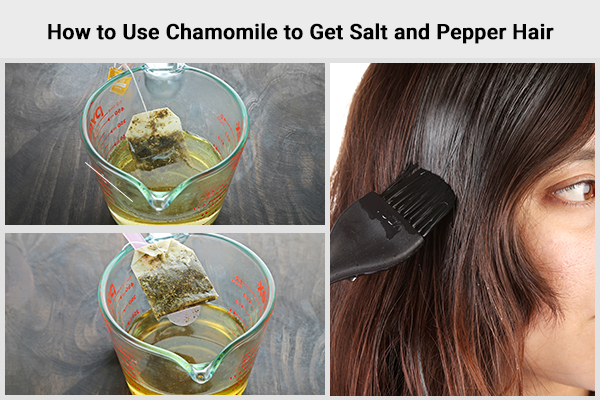
To use chamomile tea:
- Brew a pot of chamomile tea and let it cool.
- Rinse the parts of your hair you want to lighten with the cooled tea, making sure to cover all areas evenly.
- Leave it on for about 30 minutes before rinsing it off with water.
- Repeat this process once a week until you achieve the desired result.
b. Honey
Honey is a natural hair lightener and can help gradually lighten hair. The enzymes in honey produce small amounts of hydrogen peroxide through a natural process called enzymatic oxidation.
When honey is applied to hair, the low concentration of hydrogen peroxide breaks down the melanin pigments in the hair, resulting in gradual lightening. (4)(5)
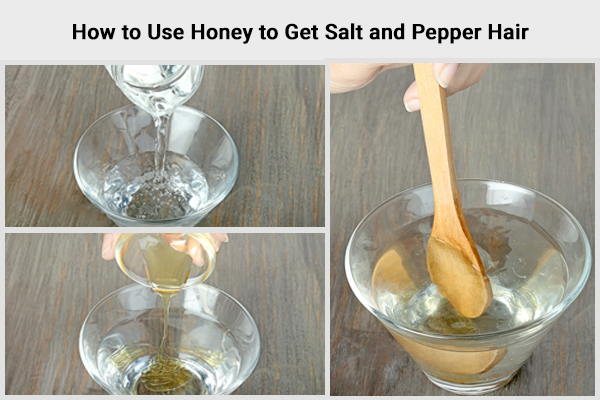
To use honey:
- Mix equal parts honey and water.
- Apply the mixture to the areas of your hair you wish to lighten.
- Leave it on for about 30 minutes, and then rinse it off with water.
- Do this once a week.
c. Baking soda
Studies have shown the effective bleaching activity of baking soda or sodium bicarbonate (NaHCO(3)), implying how it can be used as a bleaching agent for hair. (6)

To use baking soda:
- Mix equal parts baking soda and water.
- Apply the mixture where you wish to have lighter hair.
- Leave it on for about 15–20 minutes, and then rinse it off with water.
- Do this once a week.
d. Lemon juice
Lemon juice can help lighten hair gradually as it can break down the pigment or melanin in your hair. Melanin is what gives your hair its natural color. (7)

To use lemon juice:
- Mix equal parts lemon juice and water.
- Apply the mixture to your hair.
- Leave it on for about 20–30 minutes, and then rinse it off with water.
- Optionally, you can wash your hair with a mild shampoo.
- Repeat this process once a week.
2. For light-colored hair such as gray, white, or blonde hair
If you have light hair, you can darken selected parts with natural dyes to get the salt and pepper hair you want. Make your hair your canvas and play with the shades of black, gray, and white to get your desired salt and pepper hair.
a. Walnut extracts
Walnut extracts were used by the Romans to dye their hair black. You, too, can dye selected parts of your white or gray hair to get strands of black in between. The same can be done for blonde hair. (8)
To use walnut extracts:
- Crush 10–12 walnuts into small pieces and boil them in 2 cups of water.
- Strain the liquid and allow it to cool to get the walnut extract.
- Apply the walnut extract to your hair.
- Wait for 15–30 minutes.
- Cover your hair with a shower cap, and leave it on for 30–45 minutes.
- Rinse your hair thoroughly with water.
You can change the concentration of the walnut extract to achieve darker or lighter shades of black. For example, you can add more water to the walnut extract after step 2 for a lighter shade. If you want a darker shade, you can crush and boil 3–4 more walnuts and add them to the extract while boiling.
b. Charcoal
While using charcoal for hair dyeing may not be a common practice in modern times, it has been traditionally used as a black pigment in some cultures.
For example, in India, charcoal is prepared from twigs and wood of the tamarind tree after burning it in a closed pot, and then it is powdered to make black pigment.
It can produce a soft and fine black pigment that may blend well with natural hair color, giving a natural-looking salt and pepper look for people with white or gray hair. (9)
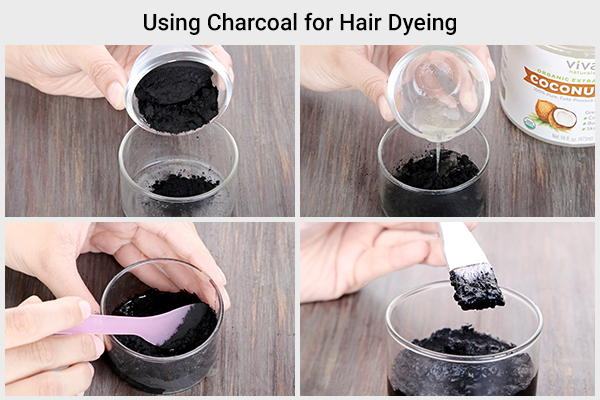
To use charcoal:
- Mix charcoal powder with water or a carrier oil such as coconut oil to make a paste.
- Apply the paste to clean, dry hair, focusing on the areas you want to dye black.
- Leave the paste on for a few hours or overnight, depending on how dark you want the color to be.
- Rinse the hair thoroughly with warm water until the water runs clear.
c. Jatamansi
Jatamansi is an herb that has been traditionally used in herbal hair colorants to provide a natural blackening effect on hair. A study conducted on sheep wool fibers and humans evaluated the effectiveness of its hair-coloring action. (10)
The study concluded that jatamansi was responsible for providing maximum hair blackening. Therefore, jatamansi can be used for getting salt and pepper hair naturally.
To use jatamansi:
- Obtain jatamansi powder from a trusted source.
- Mix the jatamansi powder with water to make a paste.
- Apply the paste to clean, dry hair, focusing on the areas you want to color.
- Leave it on for an hour or so.
- Rinse the hair thoroughly with warm water.
d. Amla
Research supports the use of amla or Indian gooseberry, which has natural pigmentation, to darken hair. (10)
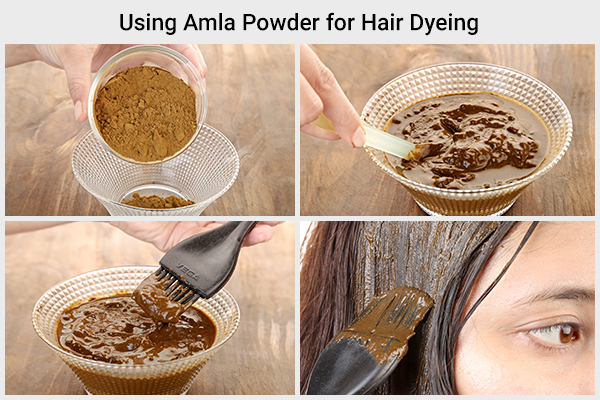
To use amla:
- Obtain fresh or dried amla powder from a trusted source.
- Mix the amla powder with water to create a paste.
- Apply the paste to clean, dry hair, ensuring that all strands are covered.
- Leave the paste on for at least one hour or longer for a darker color.
- Rinse the hair.
Limitations of Natural Ways of Getting Salt and Pepper Hair
It’s important to note that these natural methods may not produce dramatic results and may take some time to deliver the desired effect.
Also, keep in mind that excessive use of natural hair lighteners can cause damage to the hair, so it’s best to use these methods in moderation.
Additionally, using natural ways for hair dyeing may not be as effective or long-lasting as synthetic hair dyes, and your hair may require more frequent touch-ups.
Most-Asked Questions About Salt and Pepper Hair
How long does it take to achieve salt and pepper hair naturally?
The time required to achieve salt and pepper hair naturally varies depending on the method used and individual factors such as hair texture and color. Generally, it may take a few weeks to a few months to see noticeable results.
Are natural methods of achieving salt and pepper hair safe?
Most natural methods of achieving salt and pepper hair are considered safe for the hair. However, it’s still important to perform a patch test before using any new ingredient or method to ensure that you’re not allergic to it.
Can natural methods of achieving salt and pepper hair be used on all hair types?
Yes, natural methods of achieving salt and pepper hair can be used on all hair types, including straight, curly, and textured hair.
Can natural methods of achieving salt and pepper hair be used on color-treated hair?
It’s best to wait until the color-treated hair grows out before using natural methods.
Final Word
Achieving salt and pepper hair naturally is possible with the use of various natural ingredients and methods. It’s important to understand that the process of reversing hair color is not instantaneous and may require time and patience.
Additionally, using natural methods is generally considered safer for the hair compared to chemical treatments. However, it’s still important to exercise caution and perform a patch test before using any new ingredient or method.
Overall, embracing one’s natural hair color, whether it be salt and pepper or any other shade, can be a beautiful and empowering experience.
- Was this article helpful?
- YES, THANKS!NOT REALLY

