


In this article:
Many people live under the impression that vaping is not so bad for their health. They believe that as long as what they smoke is not a cigarette, it is good to go, but the truth is vaping can be extremely harmful to you.

If you don’t know what vaping is, you can think of it as an inhalation of a liquid that is filled with chemicals. These chemicals are toxic for most body parts, including your hair. (1)
Many experts and dermatologists agree that vaping can lead to hair issues and, in extreme cases, can also cause hair loss. However, there is a lack of proper research to support this statement.
However, experts and public opinion do point toward possible hair loss from vaping.
Let us look at how and why vaping can cause hair loss.
Why Is Vaping Linked to Hair Loss?
Vaping can cause hair problems and loss due to the following reasons.
1. Increased body temperature
When vaping, the vapor is cooler than 215 °C, but the vape’s heating parts can get hot.
Surprisingly, even if you’re just around someone vaping, you can have high oral temperature afterward, indicating that there’s heat in the vapor. (2)
This finding suggests that vaping might affect the hair because a high body temperature isn’t good for the hair and can lead to hair loss.
2. Constriction of blood vessels
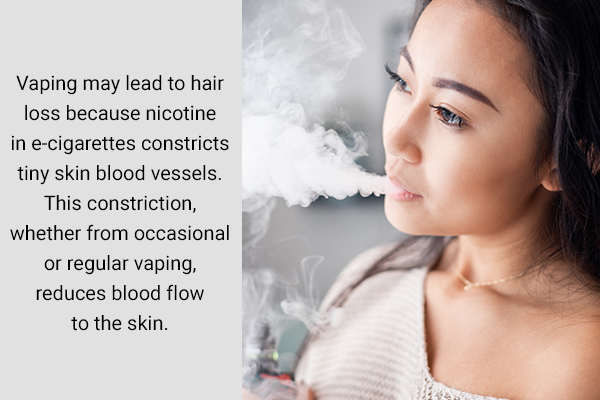
Vaping may lead to hair loss because the nicotine in e-cigarettes constricts tiny skin blood vessels. This constriction, whether from occasional or regular vaping, reduces blood flow to the skin.
Nicotine doesn’t just fail to enhance the narrowing effect of norepinephrine; it also hinders the skin’s ability to dilate the blood vessels in response to acetylcholine. (3)
A study on restoring hair with preauricular flaps revealed more complications in smokers than nonsmokers, suggesting that nicotine-induced constriction increases the risk of poor healing after surgery.
For this reason, doctors often advise people to quit vaping before hair transplants, even though there’s no specific research on this. (3)
3. Increased stress and disrupted hair cycle
Vaping can lead to hair loss by causing stress to the hair follicles.
Studies show that the chemicals in vape smoke create free radicals and mess with the body’s natural balance. This disruption prompts cells in the hair follicles to release substances that block hair growth. (3)(4)
The interaction of these chemicals with your DNA can lead to mutations and early cell death, affecting the hair growth cycle and making the hair fall out sooner than it should. (5)
4. Hair follicle destruction
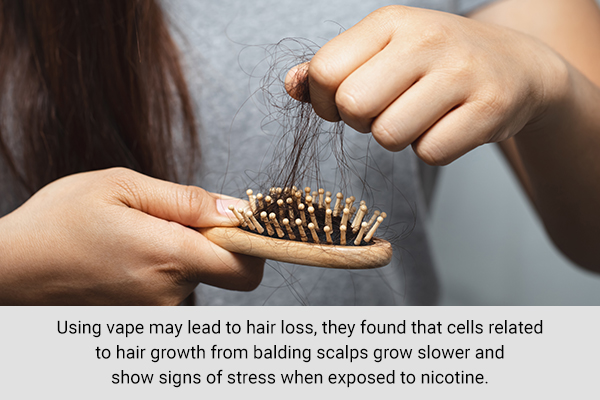
Using vape may lead to hair loss, according to researchers. They found that cells related to hair growth from balding scalps grow slower and show signs of stress when exposed to nicotine.
Nicotine causes inflammation, tissue remodeling, and collagenase activity, which lead to hair follicle damage. It can also desensitize receptors, activating cell death pathways and contributing to hair loss. (6)
In simpler terms, vaping can negatively impact the cells responsible for hair growth, possibly causing hair loss.
5. Hormonal imbalance
Smoking could lead to hair thinning because it increases certain hormones that contribute to hair loss.
Smoking is connected to higher levels of hormones such as testosterone, which could be linked to hair loss such as in cases of androgenetic alopecia. (3)
How Do You Manage Hair Loss While Vaping?
Keep your hair healthy while vaping by staying hydrated, eating well, and massaging your scalp. Choose a gentler vaping device to avoid potential hair loss from high temperatures and chemicals.
Overall, balance your vaping habits with a healthy lifestyle, including exercise and stress management, for happy and healthy hair.
How to Stop Vaping to Prevent Hair Loss?
Stopping vaping involves acknowledging its impact on health, sharing your decision with supportive friends and family, and gradually reducing usage.
Substitute vaping with healthier habits, remember the benefits of quitting, and celebrate small victories.
Moreover, be patient, stay focused on positive changes, and seek professional guidance if needed. It’s a personal journey, so find a method that works for you, and embrace the path to a vape-free life.
Most-Asked Questions
Can I get my hair back if I quit vaping?
Stopping vaping might slow hair loss, but full recovery depends on many factors. Talk to a pro for personalized advice.
How do I avoid vaping-related hair loss?
Quit vaping and adopt a healthy lifestyle with good nutrition and hydration for better overall health and hair.
Are there treatments for vaping-related hair loss?
There are options, such as topical treatments. It’s best to chat with a skin doctor for the proper advice and treatment tailored to you.
Final Word
Vaping can mess with your body in ways you might not expect, impacting your hair health. The heat and chemicals in vape smoke might mess up your hair growth, making it fall out sooner than it should. Nicotine, the main culprit, can cause problems too.
- Was this article helpful?
- YES, THANKS!NOT REALLY

