


In this article:
Applying conditioner is beneficial for all hair types, including dry and thin hair. Experts and professionals recommend using conditioner because the right one can significantly improve the health of your hair.

Modern shampoos are designed to remove dirt, oil, and other unwanted things from your hair and scalp. However, they can also strip away the natural conditioner of your hair, called sebum. (1)
To make up for this loss, conditioners were created. So, it is good not to skip conditioner, especially for dry and thin hair.
Read on to learn more.
Why Should You Use Conditioner on Dry or Thin Hair?
Conditioners offer a range of benefits for dry hair. Some of these benefits are as follows. (2)
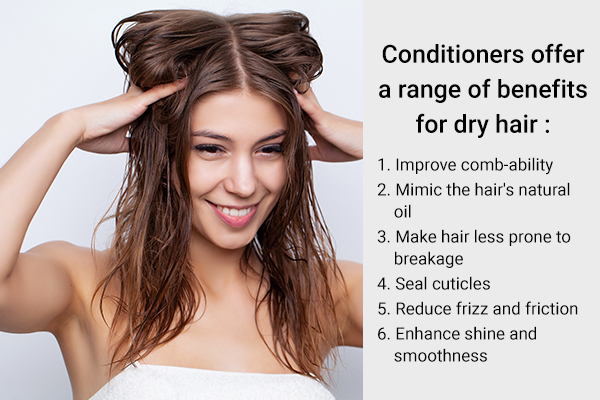
1. Improve combability
Dry hair can become tangled and difficult to comb, leading to breakage and split ends. Conditioners help detangle the hair, because of which you can comb your hair with ease without causing any damage.
2. Mimics the hair’s natural oil
The natural oils produced by the scalp help to keep hair healthy and hydrated. However, these oils can be stripped away by harsh shampoos or environmental factors, leaving the hair dry and brittle.
Conditioners can mimic the hair’s natural lipid outer layer, providing it with the nourishment and protection it needs to stay healthy.
3. Makes hair less prone to breakage
Hydrophobicity refers to the ability of the hair to repel water. When hair loses its hydrophobicity, it becomes more prone to damage from water, such as swelling and breakage.
Conditioners help to restore the hydrophobicity of hair, protecting it from damage.
4. Seals cuticles
The cuticle is the outermost layer of the hair, and it plays a critical role in protecting the hair shaft from damage. If the cuticle gets damaged, the hair becomes more vulnerable to breakage and split ends.
Conditioners help to seal the cuticles, protecting the hair shaft from damage and improving its overall health.
5. Reduces frizz and friction
Dry hair can become frizzy and prone to static electricity. Conditioners help to neutralize the negative charge on hair, reducing frizz and friction and making it easier to manage.
6. Enhances shine and smoothness
Dry hair can look dull and lifeless, lacking the shine and smoothness of healthy hair. Conditioners assist in restoring the shine and smoothness of your hair.
How to Use Hair Conditioner Correctly, Especially on Dry and Thin Hair
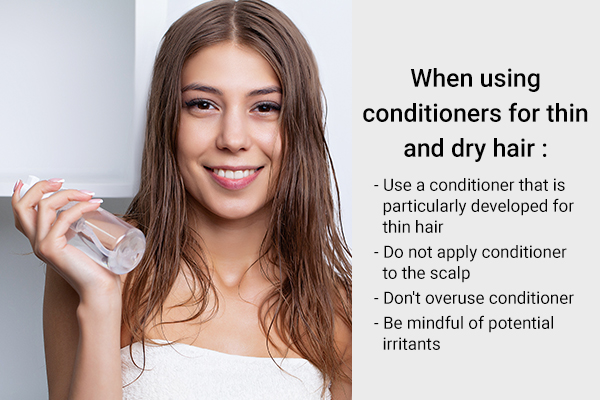
When it comes to using conditioners on thin and dry hair, it’s essential to use the right product and follow the correct procedure.
Researchers and dermatologists recommend the following. (3)
1. Use a conditioner that is particularly developed for thin hair
Make sure to select a conditioner that is suitable for your hair type and deals with your hair concerns. (3)
According to the American Academy of Dermatology, for thin or fragile hair, a moisturizing conditioner is advised to reduce breakage and split ends. They also recommend using a leave-in conditioner every once in a while. (4)
2. Do not apply conditioner to the scalp
If you have thin hair, avoid applying conditioner to the scalp. The conditioner can make the roots of the hair oily or greasy, leading to flat and limp hair.
3. Don’t overuse conditioner
Using too much conditioner can make your hair prone to breakage and brittleness, according to the experts at Johns Hopkins Medicine. Use only the amount needed to coat your hair evenly, and avoid applying it to the hair roots. (5)
4. Be mindful of potential irritants
Some conditioners may contain chemicals that can irritate the skin and cause allergic reactions. If you have sensitive skin, make sure to read the ingredients list carefully and choose a conditioner that is free from potential irritants.
Steps When Applying Conditioner
Here are the steps to properly use conditioner on your hair:
- Shampoo your hair with a gentle, sulfate-free shampoo and rinse it well.
- Gently get rid of any extra water from your hair without rubbing it harshly.
- Apply a tiny quantity of conditioner to your hair length, all the way to the hair ends, avoiding the scalp.
- Comb through your hair using your fingers or a wide-toothed hairbrush.
- Let the conditioner sit for a few minutes.
- Rinse your hair with water to remove all the conditioner.
Different Types of Conditioners and What to Choose for Dry and Thin Hair
If you have dry and thin hair, it’s important to choose a conditioner that is gentle and hydrating and does not weigh your hair down or cause buildup.
The experts from Johns Hopkins Medicines suggest looking for protein-containing conditioners, which can reinforce the strength of your hair and restore damaged strands. They are especially useful for people with dry or damaged hair. (5)
The American Academy of Dermatology also recommends using a moisturizing conditioner for fragile and thin hair. (4)
So, if you have thin or dry hair, look for conditioners that are very moisturizing in nature and have a high protein content.
Should Conditioner Be Used Daily?
For thin or fine hair, experts suggest avoiding daily use as it can make the hair look greasy. However, for thick, curly, or coarse hair, using conditioner daily can help moisturize and prevent frizz. (5)
Generally, professionals recommend using conditioner 2–3 times a week and a leave-in conditioner or hair mask once a week for dry or damaged hair.
Most-Asked Questions About Using Conditioners on Hair
How often should I use conditioner on my hair?
Typically, it’s recommended to use conditioner 1–2 times a week for normal hair and more often for dry or damaged hair. (1)
Should I apply conditioner to my scalp?
It’s not necessary to apply conditioner to your scalp, especially if your hair is naturally oily.
How is a rinse-out conditioner different from a deep conditioner?
Rinse-out conditioners are used instantly after shampooing and are rinsed out after a short period of time. Deep conditioners are left on the hair for a lengthier period to moisturize the hair more deeply. (5)
Can overuse of conditioner damage my hair?
Overuse of conditioner can make your hair brittle and prone to breakage.
Final Word
In conclusion, using a conditioner is beneficial for all hair types, including dry and thin hair. It is important to choose a product suitable for your hair type.
Look for conditioners that are gentle, hydrating, and protein-containing to strengthen and restore damaged hair.
- Was this article helpful?
- YES, THANKS!NOT REALLY

