


In this article:
It can be frustrating to correctly do every step in your hair care regimen and still experience increasing hair fall. You may have stocked the right conditioners and shampoos and serums, but sometimes none of them seem to be enough.

Some people go to lengths to ensure their hair health – they get weekly hair spas and hot oil massages – but still their hair fall won’t stop. Well, this is because many times the culprit behind increasing hair fall is something you wouldn’t have imagined.
In daily life, people often do things that seem normal and okay but surprisingly are pretty bad for hair health and might be increasing hair fall.
Continue reading to learn what these things are so you can protect your hair from them.
Surprising Things That Might Be Increasing Your Hair Fall
Here are certain things that might be a normal activity or habit to you but can be damaging your hair health, leading to increased hair fall.
1. Wearing Tight Hairstyles
Tight hairstyles such as the Ariana Grande pony or Kendall Jenner slick hair bun are very much in fashion today. From little girls to grown women, everyone seems to be obsessed with these hairstyles.
But did you know that tight hairstyles can lead to increased hair loss? This is a common problem called traction alopecia (TA), which occurs when tight hairstyles put a lot of unnecessary pressure on the hair, causing unwanted damage to the hair shafts and follicles.
These tight hairstyles can include braids, ponytails, buns, and even the use of certain hair accessories. The continuous pressure from these hair practices leads to loss of hair integrity as they damage the hair follicles.
In some cases, the constant tension can initiate an inflammatory reaction, resulting in redness, pustules, and papules, eventually causing hair loss. (1)(2)
The key to addressing traction alopecia lies in reducing tight hairstyles, allowing the hair and scalp to recover from the prolonged tension.
2. Not Washing Hair Enough
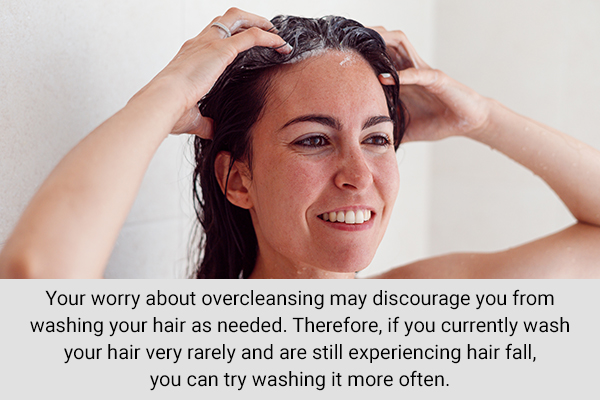
The frequency of hair washing, such as every day or just 1-2 times a week, has long been a subject of debate, often leaving many people confused.
Many women have come to believe that washing the hair a lot can cause harm to the hair by taking away the essential oils from the hair. This is why they wash their hair as little as once a week.
However, a study has found that frequent hair washing – as much as 5-6 times a week – resulted in an overall improvement in hair and scalp condition. (3)
So, your worry about overcleansing may discourage you from washing your hair as needed. Therefore, if you currently wash your hair very rarely and are still experiencing hair fall, you can try washing it more often.
Researchers suggest that the right amount of hair washing can contribute to healthier hair and a more balanced scalp, reducing the likelihood of hair fall. (3)
3. Taking Birth Control Pills
After a certain age, many women start taking birth control pills to enjoy a stress-free sex life. While these pills are a good form of contraceptive for many women and prevent unwanted pregnancies, sometimes they can cause hair fall when these pills start to influence hormone levels.
Some pills that are exceptionally rich in androgens can raise the amount of male hormones, such as testosterone in the body, which can trigger hair loss.
Hair loss can also happen when you suddenly discontinue your oral contraceptives after a long time of being on them. (4)
So, while birth control pills offer many benefits for women’s health, it’s important to be conscious of their side effects, such as hair loss.
4. Being Menopausal
When a girl enters womanhood, she starts to get her periods. This new time in her life is termed menarche, but slowly with time, the periods begin to disappear, taking the woman to a new stage of life called menopause.
The entire journey from menarche to menopause is a game of hormonal ups and downs, which is why it can also be a culprit in hair loss. For this reason, during menopause, many women undergo female-pattern hair loss (FPHL). (5)
A study focused on 200 women in the postmenopausal stage found that FPHL is more common than is thought in menopausal women, particularly those with a BMI of 25 or more. (5)
Thus, after a certain age, many women experience sudden increased hair fall, which, thankfully, can be controlled with the right treatment.
5. Smoking
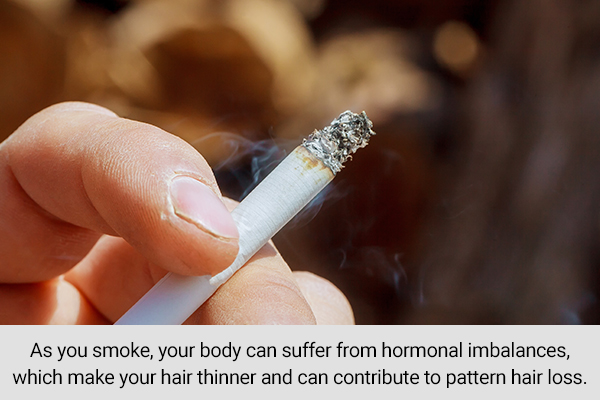
There is no secret in the fact that smoking has a lot of negative effects on the body and health. But what many people don’t know is that smoking can also be a pretty bad thing for the hair.
Researchers have concluded that the nicotine from smoking can do a lot of harm to your hair. As you smoke, your body can suffer from hormonal imbalances, which make your hair thinner and can contribute to pattern hair loss. (6)(7)
The constriction of blood vessels can also be linked to smoking. This means that your hair stops getting an adequate supply of blood, nutrients, and oxygen, and this hinders hair growth and causes hair fall. (6)(7)
6. Taking Too Much Vitamin A
Almost everyone knows that suffering from nutritional deficiencies can be bad for your hair health, but did you know that an excess of some nutrients can also be quite damaging to your hair?
Vitamin A is an essential nutrient for the body. It keeps your hair and skin healthy too. However, an excess of vitamin A causes hair loss.
When you take too much vitamin A, your hair follicles get overactivated, and they reach the end of their growth phase very quickly, which is the phase that is associated with hair fall. (8)
So, too much vitamin A can cause hair thinning and hair fall.
7. Wearing Extensions or Weaves
Many women love to play around with their hair. And since they cannot always have hair with the desired length or color, they wear extensions or weaves.
Unfortunately, most of the time, these women are not aware that weaves and extensions pull the hair and are thus very hard on hair health. (9)
This constant pulling of the hair strands by the extensions or weaves can make your hair break out. Plus, they can, in some cases, cause irreversible damage to the hair follicles. (9) All of these contribute to increased hair fall.
8. Excessive Hair Brushing
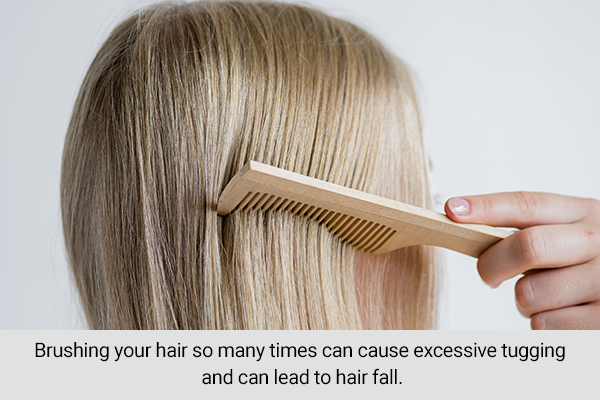
In many cultures, it is believed that brushing the hair a lot (100 strokes) every day can straighten, smoothen, and make it look super good. But alas! It is all just a myth.
In fact, brushing your hair so many times can cause excessive tugging and can lead to hair fall. Also, aggressive detangling of the hair and brushing like there is no tomorrow are never the right ways to treat your hair. (10)
So, it is best to be gentle on your hair and only brush it when necessary.
9. Tight Caps or Helmets
According to some experts, wearing hats that are too tight and make your scalp hot or sweaty can lead to a reduction in blood circulation to the hair follicles. This causes your hair to fall out with time.
However, hair loss due to this reason is often only temporary, and the hair gets better once you start avoiding tight caps or helmets.
Most-Asked Questions
How much hair fall is normal in a day?
It is normal to lose around 100 hair strands a day.
Can balding start by age 18?
Yes, some people, mostly men, do experience balding by the age of 18.
Can anemia cause hair loss?
Yes, anemia from iron deficiency can be linked to hair loss.
Final Word
Millions of people experience hair loss and thinning, which make them an incredibly common problem. These problems look simple but are actually pretty complex as determining the exact cause is almost impossible in most cases.
So, practicing good hair care and having healthy habits are the most you can do to minimize hair loss and its associated issues.
- Was this article helpful?
- YES, THANKS!NOT REALLY

