


In this article:
The hair makes up a big part of people’s outer appearance, which is why many spend hours obsessing over their hair health and fixing damaged hair.

But the question that arises is, how do you know if your hair is unhealthy and in need of some help?
The good news is that there are some indicators of poor hair health that can call your attention. The various signs of unhealthy hair mainly include: (1)
- Excess hair fall
- Poor hair elasticity
- Split ends
- Frizzy hair
- Hair dullness
- Dandruff
This article will present all the signs that you have unhealthy hair.
Signs That You Have Unhealthy Hair
Here are the common signs of unhealthy hair and how to manage it:
1. Excessive hair fall
Although hair fall is a common occurrence, excessive hair fall can be a sign that there is something not right with your hair or you have an underlying health condition.
It is natural to lose some hair as hair fall is a biological process and is a part of the hair growth cycle. It is only common knowledge that old and damaged hair is supposed to fall for the new hair to grow in its place.
However, if you start to lose more than 100 hairs in one day, it may be indicative of a severe hair problem. (2)(3)
Losing a whole lot of hair in a day is termed hair shedding and can be due to medical problems or conditions such as thyroid issues, PCOD, alopecia areata, pregnancy, and postoperative stress. (2)(4)(5)
What to do for excessive hair fall?
Performing hot oil hair massages with hair oils such as amla oil, olive oil, argan oil, and coconut oil can be very helpful for people who suffer from hair fall. This is because this habit leads to improved blood flow to the hair follicles, providing the scalp with an adequate amount of nutrients and oxygen. (6)
2. Poor hair elasticity
Hair strands are supposed to be inherently elastic. The elasticity of hair is the measure of how much the hair can stretch and still regain its ability to return to its original form without breaking.
The hair is made up of keratin fibers, which enable it to stretch and then bounce back. However, if your hair is unhealthy or damaged, they will be more prone to breaking upon stretching. (7)
What to do for hair with poor elasticity?
Omega-3 and omega-6 fatty acids are nutritional factors that moisturize the hair and keep the scalp health intact. Eating a diet rich in these nutrients can make sure your hair has high elasticity and remains smooth. (8)
3. Split ends
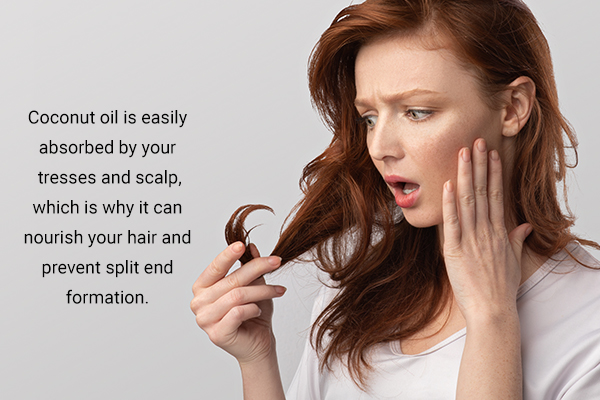
Nature has designed hair in a way that it stays protected with a proper outer covering over the hair cuticle. However, if due to any reason this layer becomes damaged, split ends may occur.
Split ends are defined as the branching of hair strands towards the ends, which makes the hair look incredibly messy and also makes it more susceptible to breaking. (1)
What to do for hair with split ends?
Coconut oil has a very good moisturizing value since it has a good content of fatty acids. This oil is easily absorbed by your tresses and scalp, which is why it can nourish your hair and prevent split end formation. (9)(10)
4. Frizzy hair
It is no secret that excessive frizziness is a sign of unhealthy hair. Nowadays, regular styling of the hair using heat styling tools or chemical-filled products is on trend, which is why more and more people fall into the frizziness trap.
Frizzy hair usually occurs because the hair is too dry and damaged, which is a reason they should not be ignored. It is better to do something to help your hair get better before it gets any worse if you experience frizziness. (11)(12)
What to do for frizzy hair?
Applying a mask that is a mix of yogurt and honey is a good home remedy to tame frizziness. Both these ingredients have very high hydrating abilities that condition the hair. (13)
You can simply combine 4 tbsp of yogurt with 1 tbsp of honey and use it as a hair mask.
5. Hair dullness
Having shiny hair is a mark of healthy hair. This is because hair is only smooth and shiny when it is structurally sound from the inside.
Any kind of pollution or chemical harm can cause your hair to lose its shine by damaging its structure. This makes your hair appear super dull and weak. (14)
What to do for dull hair?
Eggs can be a good ingredient for dull hair as they contain peptides that contribute to hair health. (15) Applying eggs as a hair mask can help nourish your hair and make it appear shiny.
6. Dandruff
Dandruff is a result of oil imbalance on the scalp. If your hair is a little too greasy or a little too dry, you can get dandruff, which can damage your hair. (16)(17)
Dandruff can cause symptoms such as flakiness and itchiness; it also promotes the accumulation of dead skin cells on the scalp, which impedes hair growth and development. (18)
What to do for dandruff?
Mixing 10-15 drops of tea tree oil with 1 tbsp of carrier oil such as coconut oil and massaging your scalp with the mixture can be good for fighting dandruff because tree tea oil is rich in an antimicrobial compound called terpinen-4-ol. (19)
Most-Asked Questions
Can dull-looking hair indicate poor hair health?
Yes, dullness can sometimes signal unhealthy hair.
Does the color of your hair reflect its overall health?
Hair color is primarily genetic and is not necessarily an indicator of health.
What measures can be taken to avoid hair tangles and mats?
Frequent hair combing or brushing can prevent tangles and mats.
Do scalp conditions impact the overall health of your hair?
Certainly, scalp conditions can influence hair growth and health.
Final Word
Unhealthy hair often shows signs, such as excessive hair loss, reduced elasticity leading to lifeless strands, the presence of split ends, and a dull, rough texture. Furthermore, an itchy, flaky scalp with uneven oil secretion can contribute to hair problems.
Understanding these indicators is important for assessing your hair’s overall health and building a suitable hair care regimen to handle these issues.
- Was this article helpful?
- YES, THANKS!NOT REALLY

