


In this article:
If you think you can have healthy hair just by focusing on your strands and not your scalp, well, you’re not on the right path!

Scalp care is a very important step in a hair care routine and is often not given enough importance. Ample research backs up the importance of scalp health in ensuring and maintaining overall hair health. (1)(2)
Therefore, investing in scalp products is not a bad idea to facilitate the healthy growth of your locks. One such product to exfoliate and cleanse the scalp is the shampoo brush.
A shampoo brush has bristles that are made up of silicone, and it is specifically constructed in a manner that supports scalp health. It does so by getting rid of dead cells or product residues from the scalp.
Moreover, a shampoo brush has a massaging effect on your scalp as it can mechanically stimulate your hair follicles by promoting blood flow to the scalp and supporting hair growth. (3)
Continue reading to learn, in detail, how a shampoo brush can benefit your scalp.
Benefits of a Shampoo Brush for the Scalp
Using a shampoo brush offers many benefits for the scalp.
1. Cleanses the scalp
Shampoo brushes have soft gentle bristles that can be beneficial for cleaning your scalp. They can remove residues or debris from the scalp with shampoo (4) by sweeping them off and by allowing the shampoo to lather effectively.
2. Increases blood flow to the scalp
Massaging your scalp with a shampoo brush increases blood flow by relaxing the blood vessels.
Stress levels also drop after a scalp massage, as shown in a study that measured the levels of cortisol (a stress hormone) before and after a scalp massage. Less stress and cortisol can improve hair health by preventing hair thinning and loss caused by stress. (3)(5)
3. Stimulates the hair follicles
Mechanobiology is the branch of science involved in studying how the body reacts to pushes and pulls. Giving your scalp a good massage with a shampoo brush can stimulate your hair follicles and make your hair grow better. (3)
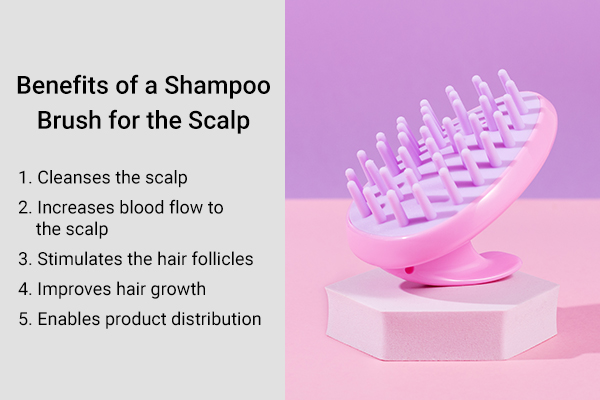
4. Improves hair growth
Shampoo brushes can benefit your scalp by giving it a gentle massage. This massage stimulates special cells at the base of your hair follicles called dermal papilla cells, which are important for hair growth. (6)
Stimulating these cells can help make your hair thicker, which is one reason why shampoo brushes can be linked to thicker hair. (3)
5. Enables product distribution
Shampoo brushes can also help evenly distribute shampoo and conditioner through your hair, ensuring that these products evenly reach all areas of your scalp and hair.
Are There Negative Effects of Using a Shampoo Brush?
Although shampoo brushes are designed with very gentle bristles and do not generally cause harm to the scalp, experts claim that if not used carefully or if used excessively, they may have the following negative effects:
- Overbrushing using a shampoo brush can cause irritation and redness of the scalp.
- Scrubbing too hard or overexfoliating can cause scalp abrasions, which further lead to itchiness.
- Being too aggressive with a shampoo brush can lead to hair breakage as wet hair tends to be very weak and susceptible to breaking.
- If you’re not careful with your use of shampoo brushes, you can end up tangling your hair, and knotting may occur.
How to Use a Shampoo Brush?
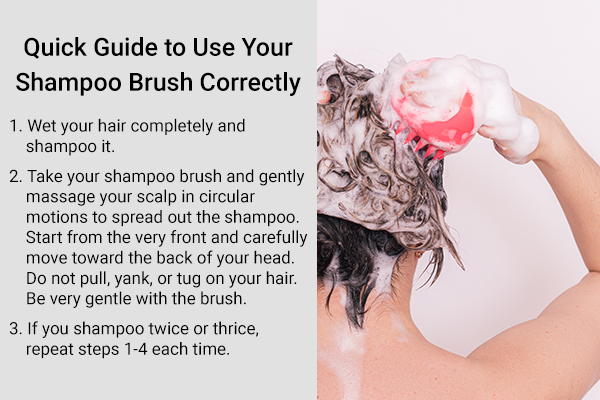
Follow this quick guide to use your shampoo brush correctly:
- Wet your hair completely and shampoo it.
- Take your shampoo brush and gently massage your scalp in circular motions to spread out the shampoo. Start from the very front and carefully move toward the back of your head. Do not pull, yank, or tug on your hair. Be very gentle with the brush.
- If you shampoo twice or thrice, repeat steps 1-4 each time.
Most-Asked Questions
Can a shampoo brush reduce dandruff?
Yes, frequent use may help decrease dandruff by promoting the cleansing of the scalp.
Is a shampoo brush suitable for all hair types?
Yes, it can be used on most hair types.
How often should I use a shampoo brush?
For promising results, 2-3 times a week is commonly advised.
Is it safe to use a shampoo brush with long hair?
Yes, but use gentle motions to avoid knotting.
Do shampoo brushes work well with curly hair?
Yes, they can work on curly hair.
Can a shampoo brush be used on children’s hair?
Yes, but with supervision and gentleness.
Final Word
Taking care of your scalp is crucial for overall hair health, and a shampoo brush can be a valuable tool in this regard. It cleanses your scalp, increases blood flow, stimulates the hair follicles, and promotes even product distribution.
However, it’s essential to use shampoo brushes with care and not to overdo it.
- Was this article helpful?
- YES, THANKS!NOT REALLY

