


In this article:
Brussels sprouts and broccoli are both popularly consumed cruciferous vegetables belonging to the Brassica family. Recently, they are emerging as vital tools in the fight against many diseases.

Although Broccoli and Brussels sprouts have slight differences, they contain similar amounts of calories, protein, carbohydrates, vitamins, and minerals. Both are low-calorie foods with low carbohydrate content.
This article will take a deeper look into and compare the health benefits of both.
Brussels Sprouts and Their Nutritional Value
Brussels sprouts resemble mini bite-sized cabbages that are often deemed as bad tasting due to their bitter taste. They contain health-benefiting polyphenols including glucosinolates, sulforaphane, carotenoids, and chlorophyll. (1)
About 1 cup of plain cooked Brussels sprouts provides 70 calories, 6 g of fiber (21% of the daily requirement), and 132 g of water.
They also contain: (2)
- 17% of the daily requirement of vitamin B1
- 19% of the daily requirement of vitamin B6
- 21% of the daily requirement of folate
- 129% of the daily requirement of vitamin C
- 237% of the daily requirement of vitamin K
- 12% of the daily requirement of both copper and iron
- 13% of the daily requirement of potassium
- 10% of the daily requirement of sodium
Broccoli and Its Nutritional Value
Broccoli looks similar to a head of cauliflower but with green florets instead of white. It is considered the “crown jewel of nutrition” and contains sulforaphane and similar polyphenols as Brussels sprouts. (3)
About 1 cup of broccoli provides 53 calories, 4 g of fiber (14% of the daily requirement), and 138.4 g of water.
It also contains: (4)
- 9% of the daily requirement of vitamin B1
- 16% of the daily requirement of vitamin B6
- 24% of the daily requirement of folate
- 154% of the daily requirement of vitamin C
- 131% of the daily requirement of vitamin K
- 9% and 6% of the daily requirement of copper and iron
- 10% of the daily requirement of potassium and only 2% of sodium
The Varying Health Benefits of Brussels Sprouts and Broccoli
The difference in nutrients between Brussels sprouts and broccoli lends them varying health benefits. Some of them include the following.
1. Blood pressure control
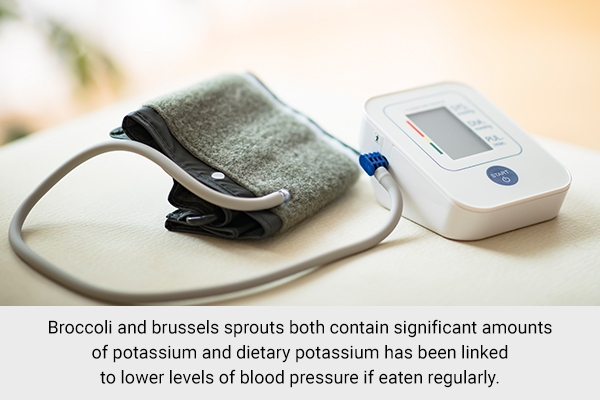
Broccoli and Brussels sprouts both contain significant amounts of potassium, and dietary potassium has been linked to lower levels of blood pressure if consumed regularly. (5)
Additionally, the sulforaphane in cruciferous vegetables such as broccoli was found useful in reducing the risk of pre-eclampsia, or elevated blood pressure in pregnant women (6)
Since pre-eclampsia is a major risk and can cause death, including broccoli in the diet can be a beneficial remedy for maintaining maternal health.
However, due to the moderately high sodium content in Brussels sprout, it is not as effective as broccoli in reducing blood pressure. This has been demonstrated by studies, where consuming more than 4 servings of Brussels sprouts per week can actually raise blood pressure. (7)
So, pick broccoli for optimal blood pressure control.
2. Diabetes management
Due to its high polyphenolic and bioactive content, broccoli is considered a functional food that can improve health outcomes, one of which is blood sugar control in type 2 diabetes.
In animal studies, broccoli supplementation for a long time improved insulin sensitivity and decreased cellular inflammation, which is a common complication of unmanaged blood sugar levels. (8)
Other studies also showed broccoli to reduce elevated blood sugar sugars and protect the cells of the pancreas and liver from oxidative damage. (9)
Studies have found cruciferous vegetables to reduce the risk of type 2 diabetes. (10) However, more recent ones have found Brussels sprouts to increase the risk of type 2 diabetes due to their glucosinolate content, (11) although a large intake is needed for them to be a risk factor.
Though more studies are needed to establish conclusive results, it is better to consume broccoli for blood sugar control.
3. Improved heart health
Cruciferous vegetables in general are good for heart health. Brussels sprouts contain glucosinolates that break down into isothiocyanates, which decrease platelet aggregation or blood clots. These clots can block blood flow and increase the chances of a heart attack. (12)
The sulforaphane from broccoli also is a significant protector against heart disease. It improves the muscle function of the blood vessels and prevents the destruction of cardiomyocytes, which are heart cells that induce contractions. (13) These contractions are necessary to maintain healthy blood flow.
For optimal heart health, both broccoli and Brussels sprouts can be consumed.
4. Better gut health
Both Brussels sprouts and broccoli are able to influence gut microorganisms to improve diversity and influence gut health. (14)
Both also contain a significant amount of fiber, which is the most effective tool in increasing gut microorganism diversity. (15)
Thus, both Brussels sprouts and broccoli are beneficial for gut health.
5. Weight reduction
Animal studies have shown that the consumption of broccoli flour prevents weight gain and the accumulation of fat in animals fed a high-fat diet. (16)
Although Brussels sprouts are less investigated, their high fiber content can be a beneficial weight loss tool as it reduces calorie intake by promoting the feeling of fullness. (17)
The fiber content of broccoli and Brussels sprouts is effective in preventing weight gain by increasing satiety and increasing the feeling of fullness.
6. Strong bones
Brussels sprouts and broccoli are abundantly rich in vitamin K, a vitamin essential for bone health. It is responsible for improving bone density and decreasing the risk of fractures, especially in postmenopausal women who are prone to osteoporosis. It also helps in increasing the protein involved in the creation of new bone cells. (18)
In addition, broccoli is also moderately rich in calcium and low in oxalates, which are also beneficial for bone health. (19)
Based on nutritional value, the vitamin K content is higher in Brussels sprouts. However, both can be consumed regularly for better bone health.
7. Immune boost
Broccoli and Brussels sprouts both contain a rich amount of vitamin C, which is a well-known vitamin that boosts immunity and prevents the occurrence of illnesses.
The sulforaphane in broccoli also acts on a cellular level and serves as a strong antioxidant; it boosts the activity of detoxification enzymes, which ultimately improves the immune reaction of the body. (20)
Brussels sprouts have a similar immune-boosting action due to their content of vitamins as well as isothiocyanates, which aid in the prevention of infections by disease-causing microorganisms. (21)
So, both broccoli and Brussels sprouts can be consumed to boost immunity.
8. Cancer prevention
Prevention against cancer is perhaps one of the most widely studied roles of cruciferous vegetables.
The isothiocyanates present in broccoli and Brussels sprouts have been termed “green chemoprevention” by experts due to their effectiveness in preventing and treating cancers such as prostate, breast, colon, skin, urinary, and oral cancers. (22)(23)
Including 1–2 servings of either vegetable can be an effective cancer-preventive strategy.
How to Cook Brussels Sprouts and Broccoli to Retain Nutrition
Though vegetables are rich in health-benefiting nutrients, most are eaten after cooking. The process of cooking and applying heat actually ends up destroying most of the vital nutrients, decreasing the nutrient content of most vegetables.
Studies have found steaming broccoli to result in the least amount of losses of vitamin C, glucosinolates, and chlorophyll as compared to stir-frying and boiling. (24)
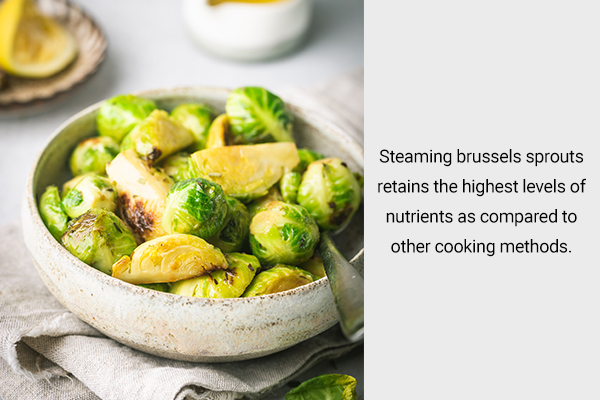
Similarly, steaming Brussels sprouts retains the highest levels of nutrients as compared to other cooking methods. (25)
Recommendations
While broccoli and Brussels sprouts both have health-benefiting properties, taste and palatability play a big role in which vegetable will be preferred. Usually, broccoli has a better flavor acceptance, especially in children.
Adding garlic, seasonings, and olive oil can boost the flavor of both vegetables.
In addition, it is recommended to:
- Pick broccoli for effective blood pressure control and managing blood sugar levels.
- Pick both for boosting immunity, building stronger bones, improving heart health, improving gut health, managing weight, and preventing cancer.
Can I Eat Broccoli and Brussels Sprouts if I Have Hypothyroidism?
Cruciferous vegetables such as broccoli and Brussels sprouts interfere with the way the thyroid gland uses iodine, and it is better to avoid eating these vegetables if you have an underactive thyroid (hypothyroidism).
Practical Takeaways
- Broccoli and Brussels sprouts are cruciferous vegetables that belong to the Brassica family.
- They are rich in nutrients including vitamin C, vitamin K, and some B vitamins and polyphenols such as glucosinolates and sulforaphanes, which give them their major health benefits.
- Broccoli offers better blood pressure management due to its higher potassium content than Brussels sprouts. Brussels sprouts are also moderately rich in sodium, which doesn’t benefit blood pressure.
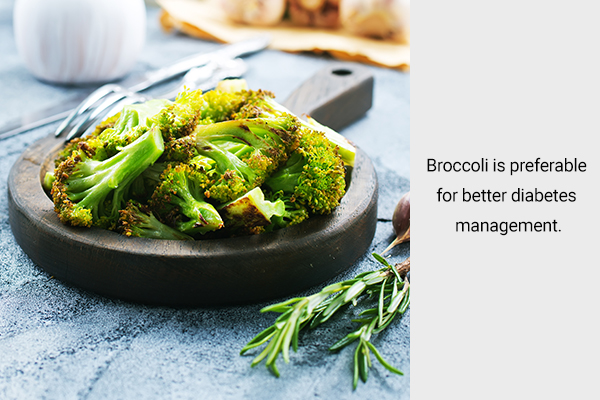
- Broccoli is also preferable for better diabetes management.
- Both vegetables can aid heart health, improve gut biodiversity, aid in weight reduction, help build strong bones, boost immunity, and prevent cancer.
- Steaming is a better way to preserve nutrients in both vegetables as compared to boiling or stir-frying.
- Was this article helpful?
- YES, THANKS!NOT REALLY

