

In this article:
After shaving, hair grows back, but sometimes, the hair curls back inward instead of coming outside of the skin. This leads to the formation of ingrown hair.

An ingrown hair is not prominently visible on the skin. It often looks like a small bump on the skin, but it is extremely itchy and causes immense discomfort to the person.
In some cases, this ingrown hair can also cause inflammation, infection, and a lot of pain.
Many people wonder what they can do to treat and manage ingrown hair at home.
Based on anecdotal evidence, one remedy that works for ingrown hair is the use of tea tree oil. This is mainly because of the various properties of tree oil such as its antimicrobial and anti-inflammatory effects. (1)
What Makes Tea Tree Oil Good for Ingrown Hair?
Tea tree oil can be used for treating ingrown hair due to its following actions.
It reduces inflammation caused by ingrown hair
Tea tree oil’s anti-inflammatory properties can soothe the area affected by ingrown hair, making it less painful.
A study revealed that terpinen-4-ol, a component in tea tree oil, can inhibit the production of inflammatory mediators, reducing the inflammatory response. Tea tree oil also alleviates skin hypersensitivity, making it suitable for ingrown hairs by modulating inflammation.
These findings support tea tree oil as a remedy for this common issue. (2)
It disinfects the affected area
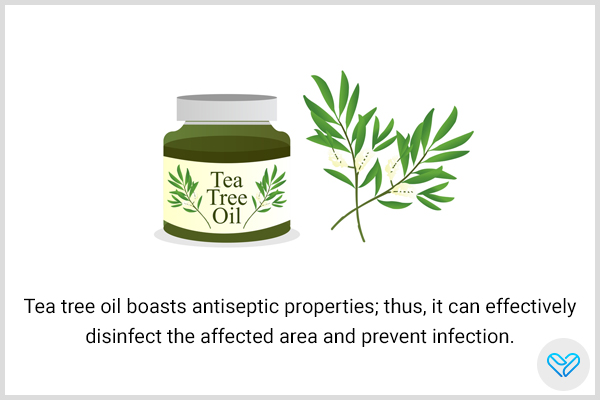
Tea tree oil boasts antiseptic properties; thus, it can effectively disinfect the affected area and prevent infection.
A study revealed that tea tree oil disrupts microbial cell respiration and increases membrane permeability. This action inhibits membrane-based metabolic processes and disrupts microbes’ chemiosmotic control, making it lethal for microorganisms. (3)
Therefore, tea tree oil keeps the area clean and free from harmful microorganisms.
It decreases itchiness in the area
Ingrown hair can cause a lot of itchiness in and around the area where it is present. Fortunately, tea tree oil has the exceptional property of being an antipruritic agent and thus can reduce itching.
Studies involving humans and animals have demonstrated this benefit.
Although large-scale research is still needed to explore the full potential of tea tree oil-based treatments, the existing evidence justifies the use of this oil and its formulations for managing itchy skin conditions. (2)
It softens the skin
According to experts, tea tree essential oil can soften the skin, which is crucial for hair that’s trapped beneath the surface.
By gently softening the skin, tea tree oil can make it easier for the ingrown hair to break through the surface and grow out naturally.
This can help reduce the pain and discomfort associated with ingrown hairs too.
Negative Effects of Using Tea Tree Oil for Ingrown Hair
Tea tree oil can be effective for ingrown hairs, but it’s important to note potential negative effects.
Studies show that Tea tree oil can lead to irritants and allergic reactions. When used in its pure form, it has caused irritation in some cases. (1)
To minimize the side effects, it’s better to use carrier oils such as coconut oil to lower tea tree oil quantity.
Allergic reactions are also possible, primarily from aged or improperly stored oil. In rare cases, tea tree oil has caused systemic effects in animals.
So, it’s wise to use tea tree oil carefully and never when it is undiluted. (1)
How to Use Tea Tree Oil for Ingrown Hair?
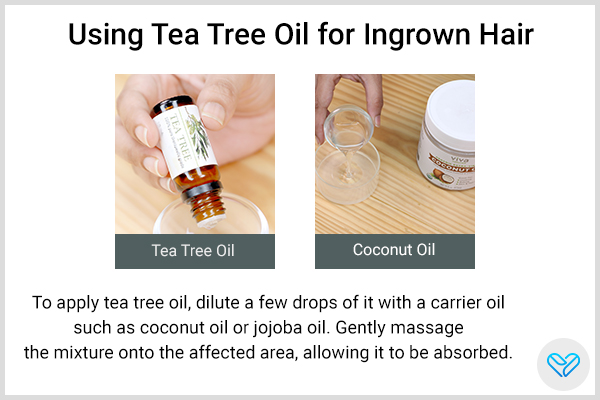
To apply tea tree oil, dilute a few drops of it with a carrier oil such as coconut oil or jojoba oil. Gently massage the mixture onto the affected area, allowing it to be absorbed.
This will alleviate inflammation, soothe irritation, and soften the skin, facilitating the trapped hair’s natural growth.
Most-Asked Questions
Is tea tree oil safe for the skin?
Tea tree oil is generally safe to be used on the skin but dilute with a carrier oil to prevent skin irritation.
How to dilute tea tree oil?
Mix a few drops of tea tree oil with a carrier oil such as coconut oil or olive oil.
How to apply tea tree oil for ingrown hair?
Use a cotton ball to apply the diluted oil.
How often do I use tea tree oil for ingrown hair?
Apply daily until the ingrown hair resolves.
How long does it take for tea tree oil to provide results for ingrown hair?
It can take a few days to a week.
Final Word
Tea tree oil is a beneficial solution for ingrown hair. It alleviates irritation and redness due to its anti-inflammatory properties, prevents infections with its antiseptic qualities, and promotes the natural growth of trapped hairs by softening the skin.
- Was this article helpful?
- YES, THANKS!NOT REALLY

