


In this article:
Being on social media means being exposed to beauty trends and obsessions. One such beauty trend that is growing quickly in the media is the use of peel-off face masks.

People can’t stop talking about how amazing peel-off masks are for unclogging your pores (1) and leaving the skin looking more radiant than ever.
However, what many people fail to realize is that these masks can actually be pretty bad for you because some of them have strong and harmful ingredients (2) that are added to give you the peel-off effect (3).
While it is true that debris and dirt come off your skin with the peel-off mask as you remove it, (1) most of the time, these masks only remove the upper layer of your blackheads without cleaning the pus inside it. Therefore, your pores may remain blocked.
In fact, according to many dermatologists, peel-off masks can cause acne problems and blocking of pores under certain circumstances as they remove natural oils from the skin and the glands have to produce more oil as compensation.
Take a look at how it is possible and what the negatives are of using peel-off masks.
What Are the Disadvantages of Using Peel-Off Masks?
There are certain cons you might face upon using peel-off masks, especially if you use them quite frequently.
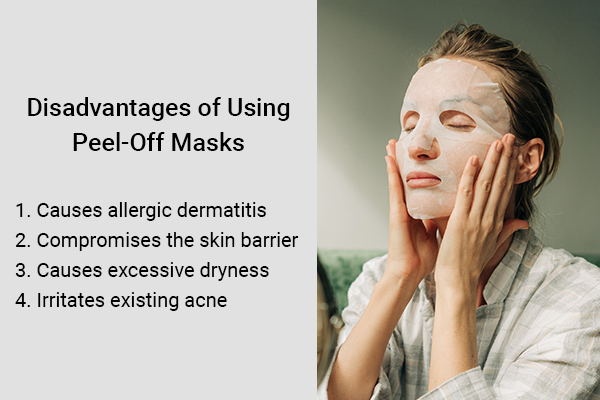
1. Causes allergic dermatitis
Dermatologists have reported an increase in cases of skin redness and itchiness following the use of peel-off masks. Experts expand on this by saying that these effects are due to the ingredients in such masks that can trigger an allergic response and cause dermatitis.
Ingredients that cause skin allergies are occlusives, which are a common find in peel-off masks. (3)
Occlusives are components that form a layer on your skin to trap moisture and keep your skin hydrated. However, research has shown that occlusives have a good tendency to cause allergic responses. (4)
According to a study, occlusion can lead to worsening of symptoms in patients with dermatitis by increasing skin inflammation. (5)
Some dermatologists even advise people with acne and eczema issues to stay far away from peel-off masks. In very severe cases, people may even experience peeling off of their skin that requires immediate professional care.
2. Compromising the skin barrier
Peel-off masks, despite their satisfying peeling effect, can be rather unkind to your skin’s natural balance.
When you peel them off, they not only take away a layer of dead skin cells but also remove some of the essential oils that give your skin its natural defense.
This leaves your skin exposed to external stressors such as pollutants and UV rays, making it susceptible to damage. (6) Thus, the intense peeling process can weaken your skin barrier upon continuous use.
So, while these masks can provide an instant feeling of cleanliness, it’s important to consider that their prolonged use might not be skin friendly.
3. Causes excessive dryness
To ensure your peel-off masks dry quickly on the skin and you do not have to wait for hours to take them off, drying ingredients such as alcohol are added. (3)
Plus, the intense peeling action of such masks can take away the natural oils from the skin’s surface.
All of this can add up and leave your skin feeling very dry and dehydrated upon continuous use.
4. Irritates existing acne
People who already have acne and suffer from skin problems should completely avoid using these masks. The peeling action of such masks has the potential to aggravate acne and worsen breakouts. (2)
What to Remember If You Still Want to Use Peel-Off Masks?
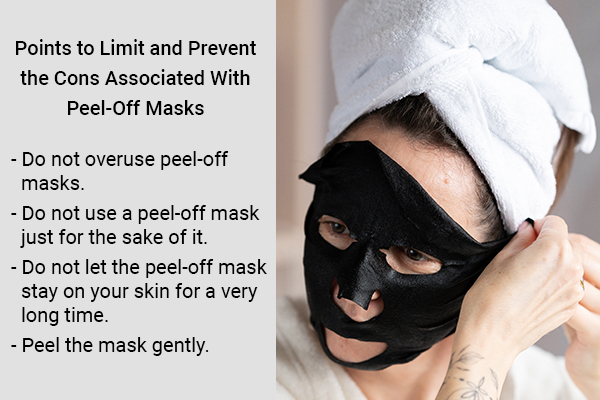
To limit and prevent the cons associated with peel-off masks, remember these points:
- Do not overuse peel-off masks. It is best to use them a maximum of once per week to give your skin a break.
- Do not use a peel-off mask just for the sake of it. Do your research and find the mask that suits your personal requirements and skin type.
- Do not let the peel-off mask stay on your skin for a very long time.
- Peel the mask gently and never be too aggressive when peeling the mask off.
- Do not shave, wax, or thread before using a peel-off mask.
Most-Asked Questions
Should I use a peel-off mask daily?
Never! Do not use peel-off masks more than once a week.
Do you need to wash your face after using a peel-off mask?
It is not necessary to wash your face after a peel-off mask, but if you want, you can simply go for a cold-water rinse.
Does a peel-off mask help get rid of pimples?
No, peel-off masks are not recommended for reducing pimples.
Final Word
Peel-off masks can have drawbacks, including inducing allergic dermatitis, weakening the skin’s defenses, and causing dryness. For some, they can worsen acne.
To use them safely, limit usage to once a week, choose the right mask for your skin type, peel gently, and avoid using them right after shaving or waxing.
Remember not to blindly follow trends and to always prioritize your skin’s health.
- Was this article helpful?
- YES, THANKS!NOT REALLY

