

Menu
eMediHealth Logo
Subscribe
No Result
View All Result
eMediHealth Logo
Subscribe
No Result
View All Result

Home > Nutrition > 5 Tips to Make Healthy Caesar Salad

5 Tips to Make Healthy Caesar Salad

Updated on June 23, 2023
5 min read
By Shiza Khan, M.Sc. – Clinical Nutrition & Dietetics | Dietitian/Nutritionist

In this article:

  • How to Make a Caesar Salad Healthy
  • Most-Asked Questions About Consuming Caesar Salad
  • Practical Takeaways

The idea that a salad might not be healthy can be a shocking truth to accept. However, you need to take a look at the ingredients of a traditional salad first.

how to make Caesar salad healthy?

Created in 1924 by an Italian native, Caesar salad was assembled with whatever he had on hand: romaine lettuce, parmesan cheese, bread cubes, eggs, olive oil, and lemon juice. It was largely a flavor-based dish and focused very little on nutrition. (1)

Then, some ingredients were changed around, but overall, the salad still offers very little nutritional value and is rich in calories that come from the fried bread cubes, added sugar, and a rich serving of mayonnaise.

So while it may be tasty, Caesar salad is not a very healthy food, especially for regular consumption.

Advertisements

The good news is you can make some changes to make it a healthy addition to your diet.

How to Make a Caesar Salad Healthy

If you wish to consume a bowl of Caesar salad, here are some easy swaps you can make to turn Caesar salad into a healthy and filling meal.
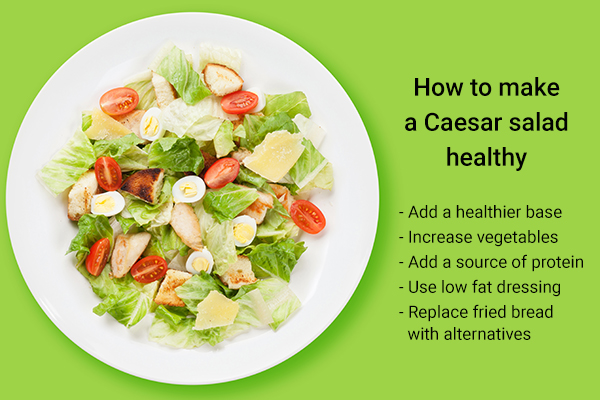
few easy ways to make a Caesar salad healthy

1. Add a healthier base

In a Caesar salad, lettuce is used as a base. Though it is an excellent low-calorie food, it offers little nutritional value as compared to other green leafy vegetables. (2)

Instead, you can choose baby spinach, kale, or arugula as an alternative or along with lettuce to boost the polyphenol content of your salad. These leafy greens can offer the following benefits:

  • Reducing the risk of heart disease and lowering blood pressure (3)
  • Improving brain health and reducing cognitive decline (4)
  • Improving bone health by providing vitamin K, which is involved in the creation of new bone cells (5)
  • Protecting against damage to the colon and preventing the risk of cancer (6)

If you do want to use lettuce as a base, then use green lettuce instead of red lettuce because it is healthier than red lettuce.

2. Increase vegetables

Adding vegetables to your Caesar salad can boost the nutritional value of your meal. Choose options such as onions, bell pepper, cucumber, broccoli, peas, and corn.

Advertisements

Studies have shown that daily consumption of vegetables:

  • Reduces the risk of heart disease (7)
  • Improves blood sugar control in type 2 diabetes (7)
  • Provides antioxidants that reduce the damage to cells caused by free radicals (8)
  • Helps in weight management (8)

In addition to providing the above benefits, vegetables add fiber to the diet, which is effective in improving the outcomes of constipation. (9)

3. Add a source of protein

Protein sources such as chicken and turkey can make your salad a complete meal. Not only does protein help increase satiety and keep you feeling full for longer, but it also aids in weight loss. (10)

Choose chicken breast as it has less fat and contains no cholesterol. (11) Additionally, choose low-fat cooking options such as grilling or baking to prepare your chicken.

4. Use low-fat dressing

Traditional Caesar salad dressing uses a lot of oil and mayonnaise, which can increase the caloric content of the salad.

Greek yogurt is a great alternative to a mayonnaise-based dressing as it provides a similar creamy flavor. It will also promote gut health by increasing the population of good bacteria, which increases immunity and promotes healthy aging. (12)

Advertisements

Prepare a Greek yogurt dressing by combining 1 tablespoon of yogurt, 3 cloves of crushed garlic, salt, black pepper, juice of half a lemon, and ½ tablespoon of olive oil.

5. Replace fried bread with alternatives

The croutons used to add crunch and texture to Caesar salad are often deep-fried bread pieces, which add a lot of calories to the meal, making it unhealthy.

A healthier alternative to adding a variety of textures is by using nuts. Chopped and toasted almonds, pistachios, or walnuts are great options. Nuts will also enhance the nutritive value of a Caesar salad.

Studies have found that regular consumption of nuts: (13)

  • Aids in reducing obesity
  • Lowers blood pressure to some extent
  • Improves blood sugar control in diabetes
  • Reduces the risk of heart diseases

Most-Asked Questions About Consuming Caesar Salad

Can children eat Caesar salad?

Yes! You can customize your salad by adding preferred vegetables and green leafy vegetables. You can also add 1 serving of boiled pasta to make it a fun meal.

What can be used in place of nuts if I have a nut allergy?

You can use whole-grain bread and toast it in a pan or crisp them in an air-fryer. You can also roast chickpeas or use baked veggie chips.

Practical Takeaways
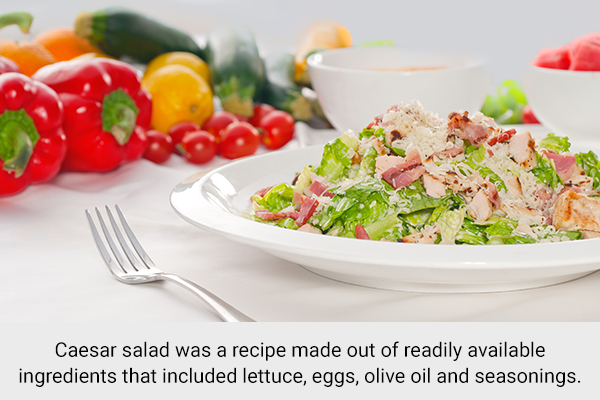
practical takeaways regarding consuming Caesar salad
  • Caesar salad was a dish made out of readily available ingredients that included lettuce, eggs, olive oil, and seasonings.
  • All these ingredients are high in calories, and lettuce offers little nutritional value as compared to other green leafy vegetables, making Caesar salad a poor choice for health promotion.
  • Making some healthy swaps can boost the nutritional value of Caesar salad.
  • Use kale, baby spinach, or arugula instead of or in addition to lettuce leaves.
  • Add more vegetables to boost fiber and micronutrient content.
  • Replace a high-fat dressing made of mayonnaise with a low-calorie one made of substitutes such as Greek yogurt.
  • Add grilled chicken or turkey breast to add protein and make it a complete meal.
  • Instead of using friend croutons, use toasted nuts, veggie chips, or roasted chickpeas to add crunch and flavor.
References
  1. Salad. Encyclopædia Britannica. https://www.britannica.com/topic/salad. Published April 6, 2023.
  2. Opazo-Navarrete M, Burgos-Díaz C, Soto-Cerda B, Barahona T, Anguita-Barrales F, Mosi-Roa Y. Assessment of the nutritional value of traditional vegetables from southern Chile as potential sources of natural ingredients. Plant foods for human nutrition (Dordrecht, Netherlands). December 2021. https://www.ncbi.nlm.nih.gov/pmc/articles/PMC8577856/.
  3. Pollock RL. The effect of green leafy and cruciferous vegetable intake on the incidence of cardiovascular disease: A meta-analysis. JRSM cardiovascular disease. https://www.ncbi.nlm.nih.gov/pmc/articles/PMC4973479/. Published August 1, 2016.
  4. Morris MC, Wang Y, Barnes LL, Bennett DA, Dawson-Hughes B, Booth SL. Nutrients and bioactives in green leafy vegetables and cognitive decline: Prospective study. Neurology. https://www.ncbi.nlm.nih.gov/pmc/articles/PMC5772164/. Published January 16, 2018.
  5. Sim M, Lewis JR, Prince RL, et al. The effects of vitamin K-rich green leafy vegetables on bone metabolism: A 4-week randomised controlled trial in middle-aged and older individuals. Bone reports. https://www.ncbi.nlm.nih.gov/pmc/articles/PMC7235933/. Published April 26, 2020.
  6. Frugé AD, Smith KS, Riviere AJ, et al. A dietary intervention high in green leafy vegetables reduces oxidative DNA damage in adults at increased risk of colorectal cancer: Biological outcomes of the randomized controlled meat and three greens (M3G) feasibility trial. Nutrients. https://www.ncbi.nlm.nih.gov/pmc/articles/PMC8067874/. Published April 7, 2021.
  7. Mello Rodrigues V, Bray J, Fernandes AC, et al. Vegetable consumption and factors associated with increased intake among college students: A scoping review of the last 10 years. Nutrients. https://www.ncbi.nlm.nih.gov/pmc/articles/PMC6682864/. Published July 17, 2019.
  8. Slavin JL, Lloyd B. Health benefits of fruits and vegetables. Advances in nutrition (Bethesda, Md.). https://www.ncbi.nlm.nih.gov/pmc/articles/PMC3649719/. Published July 1, 2012.
  9. van der Schoot A; Drysdale C; Whelan K; Dimidi E; The effect of fiber supplementation on chronic constipation in adults: An updated systematic review and meta-analysis of randomized controlled trials. The American journal of clinical nutrition. https://pubmed.ncbi.nlm.nih.gov/35816465/.
  10. Moon J, Koh G. Clinical evidence and mechanisms of high-protein diet-induced weight loss. Journal of obesity & metabolic syndrome. https://www.ncbi.nlm.nih.gov/pmc/articles/PMC7539343/. Published September 30, 2020.
  11. Jung DY, Lee D, Lee HJ, et al. Comparison of chicken breast quality characteristics and metabolites due to different rearing environments and refrigerated storage. Poultry science. https://www.ncbi.nlm.nih.gov/pmc/articles/PMC9189219/. Published July 2022.
  12. El-Abbadi NH, Dao MC, Meydani SN. Yogurt: Role in healthy and active aging. The American journal of clinical nutrition. https://www.ncbi.nlm.nih.gov/pmc/articles/PMC6410895/. Published May 2014.
  13. de Souza RGM, Schincaglia RM, Pimentel GD, Mota JF. Nuts and human health outcomes: A systematic review. Nutrients. https://www.ncbi.nlm.nih.gov/pmc/articles/PMC5748761/. Published December 2, 2017.
  • Was this article helpful?
  • YES, THANKS!NOT REALLY
Spread the Love❤️
Advertisements

You Might Also Like

Nutrition

Is Banana Milkshake Good for Acid Reflux?

By Shiza Khan, M.Sc. – Clinical Nutrition & Dietetics

Read more

Newsletter

Get our BEST updates delivered to your inbox:


This site is protected by reCAPTCHA and the Google Privacy Policy and Terms of Service apply.

Categories

  • Nutrition
  • Wellness
  • Oral Care
  • Eye Care
  • Heart Health
  • Skin & Beauty
  • Women’s Health
  • Ear, Nose & Throat
  • Respiratory Health
  • Web Stories

Links

  • Home
  • About Us
  • Contact
  • Privacy Policy
  • Terms and Conditions
  • Cookie Policy
  • Editorial Policy
  • Advertising Policy
  • Subscribe to Newsletter
eMediHealth

This site provides content for informational purposes only. The information provided is not intended for use as medical advice, diagnosis, or treatment. In case of a medical concern or emergency, please consult your healthcare provider.

This website is certified by Health On the Net Foundation.

Our Network: Little Extra

© 2019 eMediHealth. All rights reserved.

No Result
View All Result
  • Nutrition
  • Skin & Beauty
  • Wellness
  • Yoga & Meditation
  • Women’s Health
  • Heart Health
  • Allergy & Immunology
  • Bones & Joints
  • Child Health
  • Digestive
  • Ear, Nose & Throat
  • Eye Care
  • Glands & Hormones
  • Health News
  • Infectious Diseases
  • Mental Health
  • Nervous System
  • Oral Care
  • Pain Management
  • Respiratory Health
  • Sleep Disorders
  • Urological Health
  • Web Stories

© 2019 eMediHealth. All rights reserved.
