

Menu
eMediHealth Logo
Subscribe
No Result
View All Result
eMediHealth Logo
Subscribe
No Result
View All Result

Home > Nutrition > Green Tea: Is It Better Hot or Cold?

Green Tea: Is It Better Hot or Cold?

Updated on July 7, 2023
4 min read
By Shiza Khan, M.Sc. – Clinical Nutrition & Dietetics | Dietitian/Nutritionist

In this article:

  • Benefits of Cold Green Tea
  • How to Brew Cold Green Tea
  • Should You Stop Drinking Hot Green Tea?
  • How to Brew Hot Green Tea
  • What Should I Drink for Weight Loss, Hot or Cold Green Tea?
  • Practical Takeaways

Green tea consumption has risen to popularity second to coffee or tea. Just like both beverages, green tea is consumed either hot or cold.

green tea: is it better hot or cold?

People consume green tea for its rich polyphenol and antioxidant content, and knowing the optimum brewing or drinking temperature is essential to reap its maximum benefits.

Traditionally, green tea is brewed using hot (not boiling) water, but recent evidence reveals that brewing and consuming green tea at cooler temperatures are better!

Benefits of Cold Green Tea

Studies have found using water lower than 90°C to be more effective in extracting the polyphenols from green tea. In fact, the lower the temperature, the better.

Advertisements

Colder temperatures were also effective in removing the bitterness that is sometimes present in green tea. (1)(2)

Green tea brewed and drank at cold temperatures has a higher bioactive concentration, especially of gallic acid and epigallocatechin. (1) The benefit of drinking tea with high amounts of these bioactive amounts includes: (3)

  • Reduces inflammation
  • Improves bone strength by preventing the reabsorption of bone cells
  • Limiting the growth of bacteria in the mouth

In addition, drinking cold green tea is beneficial for reducing the risk of esophageal cancer, as studies have found drinking tea at temperatures higher than 60°C increased esophageal cancer risk by 90%. (4)

How to Brew Cold Green Tea

To effectively brew a cup of cold green tea, follow this process: (5)

  1. To a cup of room-temperature water, add a bag of green tea or 1 tablespoon of loose green tea leaves.
  2. Allow to steep for 30 minutes to 1 hour.
  3. Remove the tea bag and let it drip. Do not squeeze.
  4. Add honey if desired and consume.

Should You Stop Drinking Hot Green Tea?
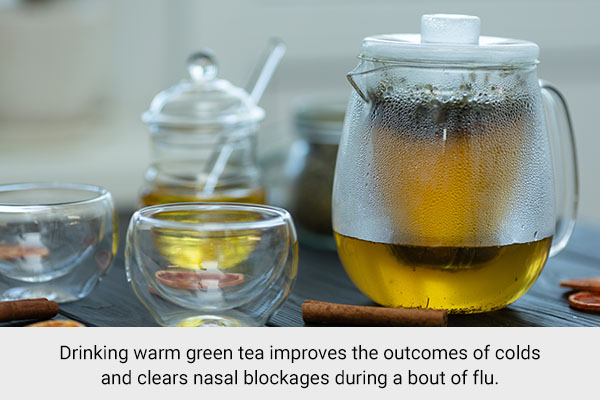
should you stop drinking hot (warm) green tea?

From the evidence available, it is evident that drinking green tea at cooler temperatures is better, but you can still drink hot green occasionally. Ensure you brew the tea in simmering water, which is around 90°C or lesser to extract its bioactive compounds.

Drinking hot or warm green tea can have some health benefits. These include:

Advertisements
  • Drinking warm green tea improves the outcomes of colds and clears nasal blockages during a bout of flu. Studies have found hot beverages to improve the outcomes of runny nose, coughing, sneezing, sore throat, chilliness, and fatigue. (6)
  • Animal studies also found warm water to improve gut microorganism biodiversity. Drinking warm green tea likely has a similar health benefit. (7)

How to Brew Hot Green Tea

Prepare a cup of hot green tea by following this process:

  1. Heat water in a kettle, but do not let it come to a boil.
  2. Pour the warm water into a mug and add a green tea bag or 1 tablespoon of loose-leaf green tea.
  3. Let it steep for 3–5 minutes.
  4. Remove the teabag and let it drip. Do not squeeze.
  5. Consume by itself or after adding honey.

What Should I Drink for Weight Loss, Hot or Cold Green Tea?

The temperature of your drinking beverage does not increase the amount of calories that are burned. However, hot green tea can improve bowel movement and improve gut microorganism diversity, (7) which can be an important addition to a weight loss diet.

Practical Takeaways
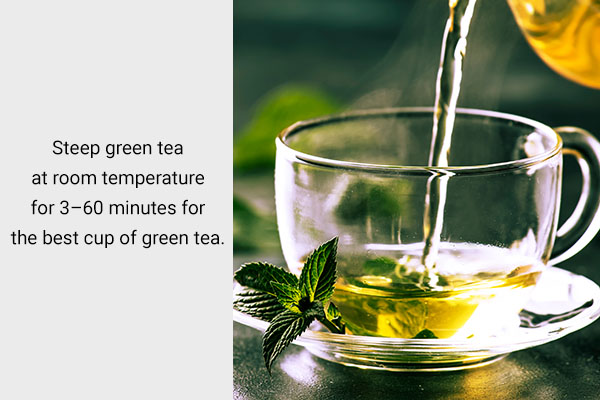
practical takeaways regarding green tea consumption
  • Green tea contains polyphenols and bioactive compounds that offer a variety of health benefits.
  • Studies suggest steeping green tea in cold water to extract the maximum amount of antioxidants.
  • Brewing green tea at cooler temperatures also removes the bitterness from green tea.
  • Steep green tea at room temperature for 3–60 minutes for the best cup of green tea.
References
  1. Lantano C, Rinaldi M, Cavazza A, Barbanti D, Corradini C. Effects of alternative steeping methods on composition, antioxidant property and colour of green, black and oolong tea infusions. Journal of food science and technology. https://www.ncbi.nlm.nih.gov/pmc/articles/PMC4648929/. Published December 2015.
  2. P; CSDEAPC. Influence of steeping conditions (time, temperature, and particle size) on antioxidant properties and sensory attributes of some white and Green Teas. International journal of food sciences and nutrition. https://pubmed.ncbi.nlm.nih.gov/26017324/.
  3. Chatterjee A, Saluja M, Agarwal G, Alam M. Green tea: A boon for periodontal and General Health. Journal of Indian Society of Periodontology. https://www.ncbi.nlm.nih.gov/pmc/articles/PMC3459493/. Published April 2012.
  4. Islami F, Poustchi H, Pourshams A, et al. A prospective study of tea drinking temperature and risk of esophageal squamous cell carcinoma. International journal of cancer. https://www.ncbi.nlm.nih.gov/pmc/articles/PMC7477845/. Published January 1, 2020.
  5. P; CSDEAPC. Influence of steeping conditions (time, temperature, and particle size) on antioxidant properties and sensory attributes of some white and Green Teas. International journal of food sciences and nutrition. https://pubmed.ncbi.nlm.nih.gov/26017324/.
  6. R; SAE. The effects of a hot drink on nasal airflow and symptoms of common cold and flu. Rhinology. https://pubmed.ncbi.nlm.nih.gov/19145994/.
  7. Wang Q, Fu W, Guo Y, et al. Drinking warm water improves growth performance and optimizes the gut microbiota in early postweaning rabbits during winter. Animals: an open access journal from MDPI. https://www.ncbi.nlm.nih.gov/pmc/articles/PMC6616395/. Published June 12, 2019.
  • Was this article helpful?
  • YES, THANKS!NOT REALLY
Spread the Love❤️
Advertisements

You Might Also Like

Nutrition

Amla (Indian Gooseberry): 10 Health Benefits and How to Eat It

By Anthony Payne, NMD, MD (Hon.)

Read more

Newsletter

Get our BEST updates delivered to your inbox:


This site is protected by reCAPTCHA and the Google Privacy Policy and Terms of Service apply.

Categories

  • Nutrition
  • Wellness
  • Oral Care
  • Eye Care
  • Heart Health
  • Skin & Beauty
  • Women’s Health
  • Ear, Nose & Throat
  • Respiratory Health
  • Web Stories

Links

  • Home
  • About Us
  • Contact
  • Privacy Policy
  • Terms and Conditions
  • Cookie Policy
  • Editorial Policy
  • Advertising Policy
  • Subscribe to Newsletter
eMediHealth

This site provides content for informational purposes only. The information provided is not intended for use as medical advice, diagnosis, or treatment. In case of a medical concern or emergency, please consult your healthcare provider.

This website is certified by Health On the Net Foundation.

Our Network: Little Extra

© 2019 eMediHealth. All rights reserved.

No Result
View All Result
  • Nutrition
  • Skin & Beauty
  • Wellness
  • Yoga & Meditation
  • Women’s Health
  • Heart Health
  • Allergy & Immunology
  • Bones & Joints
  • Child Health
  • Digestive
  • Ear, Nose & Throat
  • Eye Care
  • Glands & Hormones
  • Health News
  • Infectious Diseases
  • Mental Health
  • Nervous System
  • Oral Care
  • Pain Management
  • Respiratory Health
  • Sleep Disorders
  • Urological Health
  • Web Stories

© 2019 eMediHealth. All rights reserved.
